

I hope that it’s been a good month for you.
Sarah Schwab and I from CultureOS are hosting a webinar on Thursday 21 October about how to rethink your organisation’s cultural experiment with 6 massively important questions.
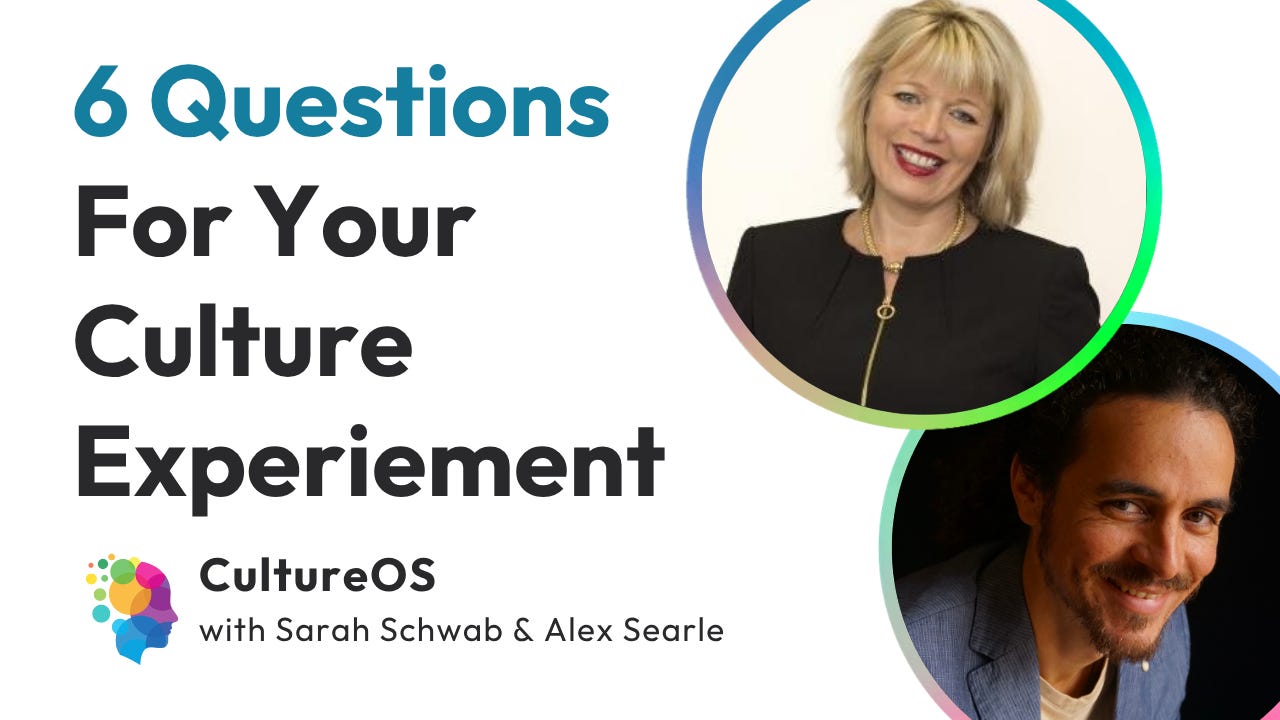
I would love for you to tune in as we will share what we’ve learned over the past year when it comes to what exactly intentional culture design looks like in practice.
We’ve also crafted 6 core questions to sit with before running any kind of experiment or initiative when it comes to behaviour change.
Curious? I hope so. Come along. There will be time for questions at the end.
Seriousness has an impostor problem
How dangerous is it to be serious?
There’s a moment in a talk on creativity where John Cleese draws a distinction that’s stuck with me for years: the difference between being serious and being solemn.
Most people treat the two as interchangeable, but they really aren’t, and mixing them up costs more than we tend to notice.
To be serious is to be dedicated and loyal. Willing to keep showing up for something, such as a career, relationship, piece of work, even when it’s difficult, especially when nobody’s watching. But solemnity is different. It’s a formality for its own sake, an instruction about how you’re supposed to feel and how you’re supposed to hold your face while you feel it.
I grew up singing the South African national anthem and a school song every Monday morning, standing straight, eyes forward, not because anyone in that hall was especially moved that week, but because that was the ritual. Nobody was checking whether pride was actually present, only whether the posture of pride was being performed correctly. It took me a long time to work out what actually bothered me about that. It wasn’t the singing, but being asked to perform a feeling I hadn’t arrived at honestly.
That’s the impostor. Solemnity borrows the credibility of seriousness and uses it to extract something else entirely: submission. When someone insists you adopt a certain gravity or deference that isn’t natural to you, they’re usually asking for your compliance. This is something to seriously interrogate.
Business is one of solemnity’s most reliable homes. It’s a place for the pointless meeting ritual nobody questions or the tone you’re expected to adopt around someone senior regardless of whether what they’re saying has earned it. None of that is really about seriousness or the quality of work being done. It’s an imposed hierarchy, wreaking of middle management dressed in seriousness’ clothes, asking you to hand over your authority without ever having to argue for why it deserves it.
The trouble is, that arrangement is running out of runway.
What replaces command and control
For a long time, formality did useful work. It signalled competence, protected hierarchy and kept large organisations legible to themselves. But a workforce that’s more distributed, more global and more able to walk if it isn’t getting what it needs doesn’t respond to solemnity the way it used to.
You can still insist on it, and for a time, people will still comply. But what’s replacing it isn’t louder authority. It’s rather something closer to relational intelligence: the capacity to read a room instead of dominate it. It involves noticing what happens in someone’s body before they’ve said a word or to talk last rather than first. Relational intelligence builds the kind of trust that doesn’t need a title to enforce it. I like to think of it as community instead of command, or listening before leading.
These aren’t soft skills in the dismissive sense that phrase usually carries. They’re becoming the actual mechanism by which respect, loyalty and performance get produced, because the old mechanism, rank plus solemnity, has stopped reliably producing them, and will only continue to do so.
There’s a second impostor worth naming and this one’s closer to home. It’s the seriousness you start imposing on yourself.
I notice it most in the moments right after something goes well. Someone tells you you’re good at what you do or a goal is achieved and for a second that’s simply true and simply enough. Then, if I’m not careful, it curdles into something else: the sense that I need to keep being that person, that the identity now has to be defended and repeated, that the world is somehow leaning on me to keep performing at that level. That’s when seriousness can cross over to ego wearing the coat of commitment.
The writer Oliver Burkeman has a line I keep returning to, about the real skill in a short life being the ability to fully feel a good moment and then let it go, rather than trying to hold onto it or build an identity out of it. It could be watching a gorgeous sunset or landing a promotion and soaking in the proud moment. All of it is real and worth having, yet none of it can be yours to keep forever, and that’s the discipline.
The things we get most serious about, like our career, status, the story we tell about our own competence, are also the things most likely to tip us from taking the work seriously into taking ourselves seriously. That’s the tell.
None of this is an argument for taking nothing seriously. Discipline and commitment still matter. The work worth doing was never going to get easier just because we stopped performing solemnity around it. But there’s a real difference between a person or an entity that holds its work with weight and one that’s simply gotten used to confusing weight with pomp and self-importance. The first can adapt, listen and let people disagree without it costing them anything. The second can only keep insisting, more loudly, on a mood nobody in the room actually feels anymore.
This is how we stay adaptable and nimble in the face of the wild demands of the future. It’s OK to be serious, as long as it’s in service of the real thing which, usually, has very little to do with you anyway.
That’s all for now. Thanks for reading.
Alex
I hope you enjoyed reading.
Humble Mind is a facilitation and social learning practice building communities, human skills and the conditions for real learning.
Website · Community · Podcast · YouTube
Questions, ideas, or just want to say hi? Reply to this email - I read everything.
All the best for now,
Alex